
 0
0

Resin 3D printing has become increasingly important as products continue to shrink in size while growing in visual and functional complexity. Today, designers are not only evaluating whether a part fits or functions correctly, but also how consistently the same part can be reproduced across multiple builds.
This shift is one of the reasons why SLA 3D printing and other resin-based additive manufacturing technologies are now widely used in industries such as electronics, medical devices, consumer products, and industrial equipment. Resin 3D printing services offer a level of precision, surface refinement, and dimensional control that is especially useful for applications where appearance and accuracy matter as much as functionality.
Similar to any manufacturing process, resin printing achieves the best results when the design works with the process rather than against it. Decisions around geometry, orientation, support placement, and surface intent made early in the design stage often determine how smoothly a part moves from CAD to a finished print.
This blog explores design for resin printing from a practical perspective and explains how small design decisions can lead to more predictable, repeatable, and high-quality results.
Understanding the Resin Curing Process in 3D Printing
Unlike extrusion-based manufacturing methods, stereolithography and other resin printing technologies build parts by selectively curing liquid resin through controlled light exposure. Each layer forms through a chemical curing reaction rather than by physically depositing material.
Because of this, resin parts do not simply stack layer by layer. They gradually take shape as each cured layer supports the next. This curing behavior influences surface finish, dimensional stability, print accuracy, and how fine features resolve during printing.
Designs that account for this curing process tend to translate more effectively from CAD to print. Smooth geometry transitions, balanced wall sections, and consistent feature distribution help the resin cure more evenly and reduce distortion during printing and UV curing stages.
Thinking in terms of how a part forms during curing, rather than only how it appears in CAD, helps align design intent with real-world manufacturing outcomes.
Balancing Detail, Stability, and Print Accuracy
One of the major strengths of high-resolution 3D printing is the ability to capture extremely fine details while maintaining smooth surfaces. At the same time, maintaining structural stability throughout the print and post-processing stages is equally important.
Highly detailed features still require enough structural support to maintain their shape during printing, cleaning, and curing. Thin walls, spacing between features, and overall part proportions all influence how accurately a part is reproduced from start to finish.
Designs that balance detail with stability typically require less corrective finishing after printing. As projects move from one-off prototypes to repeated production cycles, this balance becomes increasingly important for maintaining consistency without increasing finishing effort.
Designing Resin Features for Better Surface Finish
In precision resin printing, feature design is closely connected to final surface finish quality.
Smooth geometry transitions generally cure more evenly than abrupt design changes. Sharp edges and intricate features can still be achieved, but their placement and scale influence how cleanly they form and how support structures interact with visible surfaces.
Designing features with surface intent means thinking ahead about:
Which surfaces will remain visible
Where supports can be safely placed
Which areas can tolerate minor support marks
How much post-processing is acceptable
This approach helps preserve cosmetic quality where it matters most and reduces unnecessary finishing work later, especially for customer-facing parts and cosmetic prototypes.
Print Orientation in Resin 3D Printing
Orientation plays a major role in resin printing design guidelines and is often one of the most influential design decisions during file preparation.
How a part is oriented affects:
Support attachment locations
Surface appearance
Resin drainage behavior
Layer visibility
Post-processing effort
Considering orientation early allows designers to protect critical surfaces, manage support contact points, and improve consistency without modifying the core geometry.
When orientation is treated as part of the overall design strategy rather than a last-minute slicing adjustment, results tend to be more repeatable across builds.
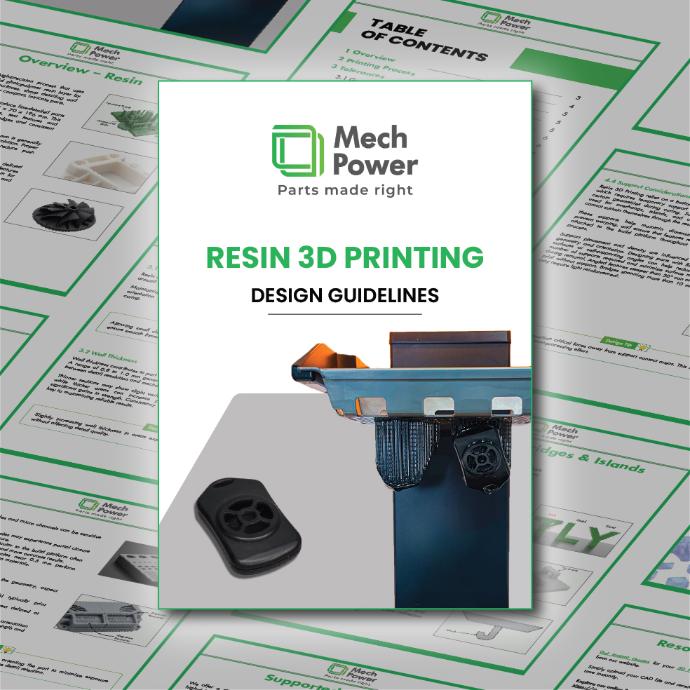
Small design decisions matter a lot in resin printing
A quick design guide can help.
Designing High-Detail Resin Parts for Real-World Applications
Resin 3D printing services are commonly used for producing detailed resin parts that require smooth surfaces, fine details, and tight dimensional control.
Common applications include:
Medical device housings
Electronics components
Cosmetic product prototypes
Transparent display parts
Engineering prototypes
Detailed product enclosures
Precision industrial components
When designing these parts, considerations such as surface finish, tolerances, wall thickness, and curing behavior become important for maintaining both appearance and functionality.
For teams developing functional or cosmetic components, applying resin printing design guidelines early in the CAD process can reduce redesign cycles and improve production consistency.
Common Resin 3D Printing Design Considerations
Successful resin 3D printing often depends on how well the design aligns with the behavior of the printing and curing process.
Some important resin printing design considerations include:
Maintaining suitable wall thickness for structural stability
Designing proper drainage paths for hollow parts
Positioning support structures away from cosmetic surfaces
Considering resin shrinkage during UV curing
Allowing proper tolerances for mating or assembly parts
Optimizing geometry for improved layer resolution
Managing surface expectations during post-processing
These considerations become increasingly important in rapid prototyping, functional prototypes, and low-volume production workflows where repeatability and appearance are critical.
Designing for Consistency Across Prints
Consistency is especially important in resin printing, where parts are often expected to match closely in both appearance and dimensional accuracy.
Designs that account for curing behavior, support interaction, and finishing expectations are generally easier to reproduce reliably across multiple builds. Thinking ahead about clearances, support placement, and surface intent supports smoother transitions from prototypes to short-run manufacturing.
This level of consistency becomes particularly valuable when resin parts are used in assemblies, engineering prototypes, or customer-facing applications where visual uniformity matters.
Why Resin Printing Design Guidelines Matter
Resin printing design guidelines work best when they act as a shared reference rather than a strict rulebook. They help teams understand how design choices influence manufacturing outcomes and provide useful context during design reviews.
By bringing together process-aware considerations, guidelines improve communication between design and manufacturing teams while helping reduce uncertainty during production planning.
Designing with Confidence in Resin 3D Printing
Designing for resin printing becomes more intuitive when there is a clear reference to guide decisions around detail, orientation, and surface expectations.
At Mech Power, we maintain resin design references as part of our Knowledge Base to support consistent, high-quality outcomes across precision and cosmetic applications. These references are shaped by real manufacturing experience and are intended to be used alongside CAD tools during design and review stages.
For teams working regularly with resin 3D printing, a consolidated design reference can be a useful companion during design reviews and final file preparation.
FAQS
Frequently Asked Questions
They are structured recommendations for designing parts compatible with the resin 3D printing process.
They help improve surface quality, dimensional accuracy, and print consistency.
Yes, wall thickness and feature spacing affect curing stability and accuracy.
Yes, process-aware design helps minimize excessive supports and surface corrections.
They are available in the Mech Power Knowledge Base.