
 0
0

FDM 3D printing is popular because it is easy to access, flexible, and works well at various stages of product development. From early ideas to functional parts, it provides a faster way to turn concepts into physical components.
What often leads to better outcomes is not changing the printer or material, but taking some time to think about how the part will actually be built. Designing with the FDM process in mind helps create parts that are easier to print, easier to finish, and more consistent across builds. Well-structured FDM design guidelines also help reduce avoidable printing issues during development.
This article shares a design-first perspective on FDM printing and explains how small decisions made early can support better results later.
Thinking in Layers, Not Just Geometry
Unlike subtractive manufacturing, FDM builds parts layer by layer. Each layer contributes to the final shape, strength, and appearance of the part.
When designs are created with this layered process in mind, features tend to translate more smoothly from CAD to print. Simple choices around how surfaces are stacked or how geometry transitions between layers often influence print stability, layer adhesion and surface quality.
This shift in thinking helps align digital models with how material is actually deposited during printing and supports better Design for Additive Manufacturing (DfAM) practices.
Balancing Strength, Weight, and Print Efficiency
FDM parts are rarely solid by default. Internal structure plays a role in how a part performs, how much material it uses, and how long it takes to print.
Instead of aiming for maximum density, effective designs balance structural needs with practical considerations. Internal geometry and infill density can support stiffness where needed while keeping overall weight and print time under control.
This balance becomes especially important as designs move from one-off prints to repeat builds.
Designing Features With the Process in Mind
Small design details often have an outsized impact in FDM printing.
Rounded transitions tend to behave more predictably than sharp corners. Feature placement influences how layers bond and how surfaces appear once printed. Even subtle changes in geometry can affect how support structures are generated and removed.
Approaching feature design with awareness of the printing process helps reduce unnecessary adjustments later.
Starting a new FDM project or prototype?
Design for strength and stability before you print.
Orientation as a Design Decision
Orientation is often treated as a slicing step, but it begins at the design stage. How a part is oriented during printing influences surface finish, strength direction, and post-processing effort.
Considering print orientation early allows designers to prioritize important surfaces and functional areas. This helps preserve appearance and performance without adding complexity to the model.
Designing for Consistency Across Builds
As projects scale beyond a single print, consistency becomes more valuable. Designs that account for FDM behavior tend to produce more repeatable results across machines, materials, and batches.
Thinking ahead about tolerances, clearances, surface expectations, and finishing needs supports smoother transitions from prototype parts to production-ready custom parts.
Materials such as PLA, ABS, PETG, and Nylon may also behave differently during printing, making process-aware design decisions even more important for predictable outcomes.
Why Design Guidelines Are Useful
Design guidelines work best as a reference, not a checklist. They provide context around how design choices interact with the manufacturing process and help teams make confident decisions.
Rather than repeating isolated rules, guidelines bring together design considerations that reflect real production experience.
Designing with Confidence in FDM
Designing for FDM becomes easier when there is a clear reference point to align design decisions with the printing process. Having access to process-aware design guidance helps teams move through design reviews with more confidence and fewer assumptions.
At Mech Power, we maintain detailed FDM design references as part of our Knowledge Base to support consistent and predictable outcomes across a wide range of applications.
For teams working regularly with FDM 3D printing, a consolidated design reference can be useful during CAD reviews and file preparation.
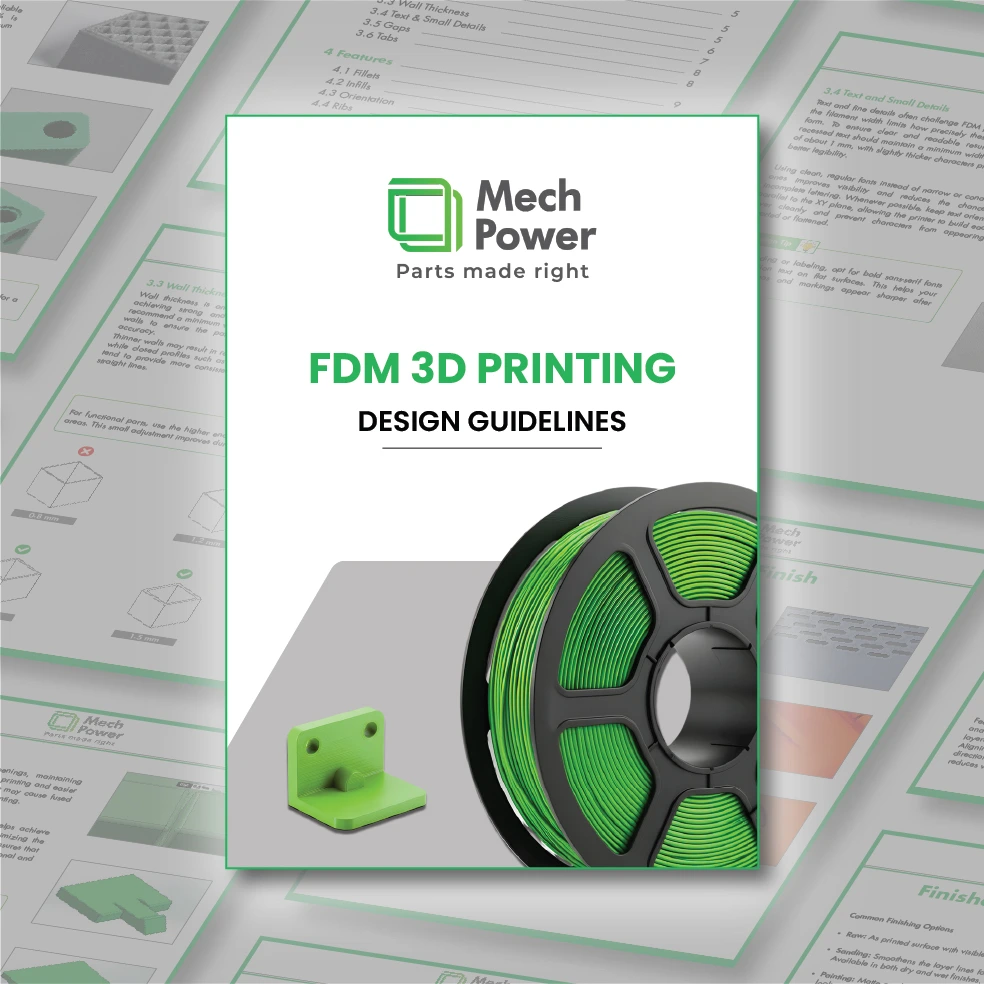
FDM Download the FDM 3D Printing Design Guidelines
FAQS
Frequently Asked Questions
They are structured recommendations for designing parts compatible with the FDM printing process.
They help improve print accuracy, strength alignment, and manufacturing consistency.
Yes, process-aware design improves first-time print success.
Yes, infill strategy affects strength, weight, and overall print efficiency.
The complete FDM 3D Printing Design Guidelines are available in the Mech Power Knowledge Base for download.