

 0
0

Thermal issues in electronic products often surface later than expected. A design that might look complete on paper may begin to struggle once the system is powered and operating continuously. In many cases, the electronics are not the real limitation. The enclosure around them has a bigger impact on how heat builds up, spreads, and escapes. Material choice, internal space, and airflow paths quietly shape thermal performance long before testing even begins.
When enclosure design ignores thermal behavior, overheating issues often appear late in testing or after deployment.
This blog explains how enclosure design directly influences thermal performance in electronic products and why early mechanical decisions matter.
Why Thermal Issues Often Appear Late in Product Development
In many development workflows, enclosure geometry is finalized early to meet size, cost, or packaging requirements. Thermal validation typically happens later, once prototypes are assembled and powered.
At this stage, material choices, spacing, and airflow paths are already fixed. If any problems appear, fixing them often requires design revisions, added vents, or forced cooling solutions.
Early prototypes may not reveal these problems because they run under limited loads or controlled conditions. Once products face real usage environments, enclosure limitations become visible.
Understanding Heat Flow Inside an Enclosure
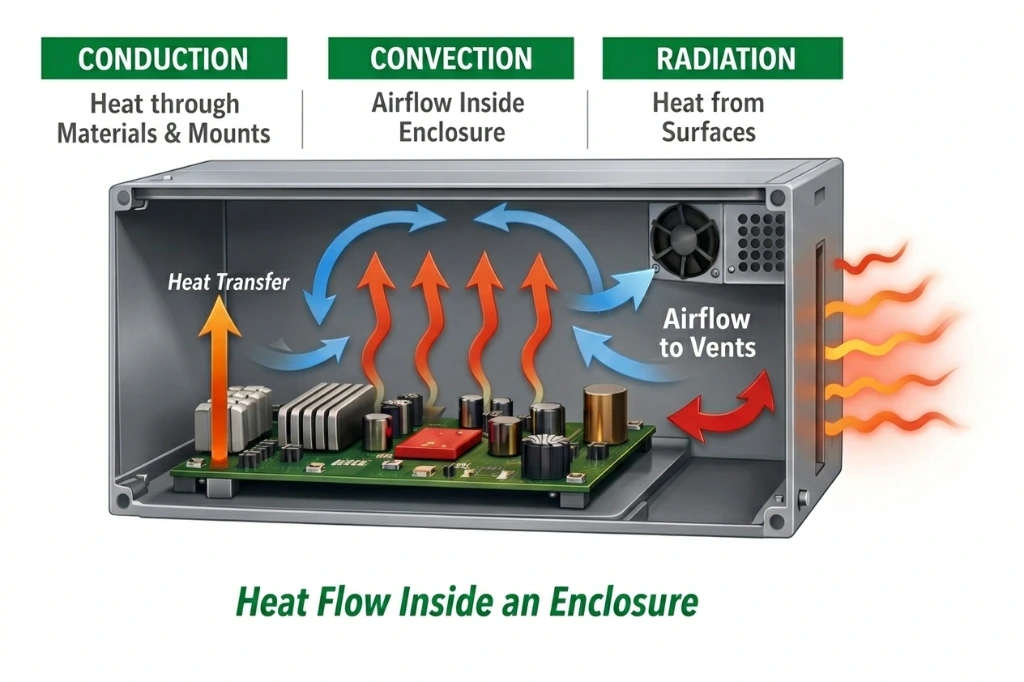
There are three main ways heat flows in an enclosure: conduction, convection, and radiation. Instead of treating these as theoretical concepts, it is more useful to understand how enclosure design influences them.
Conduction is a function of how heat flows through the materials and mounting structures.
Convection is a function of how air moves within the enclosure volume.
Radiation depends on surface properties and finishes.
Enclosure design directly affects all three, often more than expected.
Enclosure Material Selection and Thermal Performance
Material choice plays a major role in how heat is distributed and dissipated.
Aluminium enclosures are often preferred for thermal reasons because they conduct heat efficiently and help spread heat away from concentrated sources. Steel enclosures, while strong and cost-effective, tend to retain heat longer and rely more on airflow for cooling.
Material thickness also matters. Thicker walls can spread heat better but may slow heat transfer to the surrounding environment. Thinner walls respond faster but may require additional airflow planning.
At Mech Power, material selection is treated as both a structural and thermal decision, not just a fabrication choice.
Enclosure Geometry and Internal Layout
Even with the right material, poor internal layout can limit thermal performance.
Key factors include internal spacing around heat-generating components, PCB orientation, and the proximity of components to enclosure walls. Tight layouts create heat pockets and restrict air movement. Large flat surfaces without airflow paths can trap warm air.
Power density also matters. As electronics become more compact, enclosure volume reduces while heat generation increases. Without careful layout planning, thermal performance quickly degrades.
Small geometric decisions often have a larger impact than expected.
Airflow Planning and Vent Design
One of the most misunderstood aspects in enclosure thermal design is vent placement.
Effective airflow is not achieved by simply adding more vents. Air needs a clear path to enter, move across heat sources, and exit the enclosure. Poorly placed vents can cause recirculation, where warm air remains trapped instead of being expelled.
Vent location relative to heat sources, vent size, and perforation patterns all influence cooling effectiveness. Natural convection needs vertical airflow paths, while forced airflow depends on minimizing resistance.
Random or late-stage vent additions rarely solve the root problem.
Surface Finish and Its Influence on Heat Dissipation
While surface finishes are usually selected for looks or protection against corrosion, they also influence how well an enclosure handles heat.
For example, powder-coated finishes can actually reduce heat radiation depending on how thick they are and the color used. In contrast, bare metal surfaces often tend to release heat more efficiently but they may not meet environmental standards. Passivated coatings offer corrosion protection with different thermal characteristics.
Overlooking the thermal impact of surface finishes can change overall enclosure performance more than expected, especially designs that rely on passive cooling.
Passive and Active Cooling Begin With the Enclosure
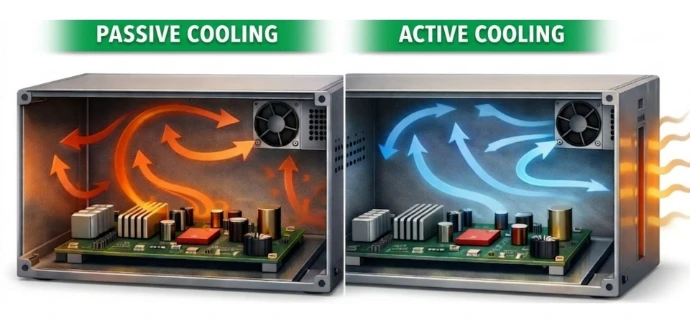
Fans, heat sinks, and thermal pads are commonly used to manage heat, but they only work well if the enclosure is designed properly.
If airflow paths are blocked or hot air recirculates inside, active cooling adds noise and power consumption without solving the problem. Passive cooling depends even more on enclosure geometry, material, and surface area.
In both cases, enclosure design forms the foundation. Cooling components can support good enclosure design but cannot compensate for poor planning.
Designing for Thermal Performance Early
When thermal considerations are integrated early in enclosure design, outcomes improve significantly.
Design teams get better predictable results during testing, fewer redesign cycles, and smoother transition from prototype to production. Certification and reliability testing also become more straightforward.
Early planning allows thermal behavior to be addressed through design rather than corrective measures.
How Mech Power Supports Thermal-Aware Enclosure Design
At Mech Power, enclosure design and manufacturing are approached together, with real operating conditions in mind.
Our customization capabilities support thermal performance through:
Functional cutouts planned for airflow and access
Surface finish selection based on application requirements
UV printing for clear and durable labeling without affecting enclosure integrity
By aligning enclosure design with manufacturing insight, we help teams build enclosures that perform reliably beyond CAD drawings. To know more about how Mech Power approaches enclosure customization, you can explore our capabilities here.
Conclusion
Thermal performance in electronics is not only an electrical challenge. It is a mechanical and enclosure design decision.
By planning materials, geometry, airflow, and finishes early, many heat-related issues can be avoided before production. Enclosure design, when done thoughtfully, supports performance, reliability, and scalability.
Want to explore enclosure design that supports reliable assembly and performance?
Get in touch with us to discuss enclosure design and customization for your application.
FAQS
Frequently Asked Questions
Yes. Even with a well-designed PCB, thermal issues can arise if the enclosure restricts airflow, traps heat, or uses materials that limit heat dissipation.
Thermal behaviour is usually evaluated after enclosure geometry is finalised. Once testing begins under real operating conditions, enclosure-related heat issues become more visible.
Materials like aluminium help spread heat more effectively, while steel enclosures rely more on airflow for cooling. The right choice depends on application, power density, and operating environment.