

 0
0

A resin 3D printed part can look clean and detailed after printing, but that does not always mean it is ready for use. Every resin 3D printed part needs basic washing and curing. Additional finishing depends on how the part will be used.
For engineers, post-processing should not be treated as the same process for every part. A fit-check prototype, hidden internal part, enclosure component, and customer-facing model may all need different finishing levels. Choosing the right post-processing step helps keep resin 3D printing practical for prototypes, custom components, and production parts.
Understanding Post-Processing for Resin 3D Printed Parts
Every resin 3D printed part goes through two basic post-printing steps: washing and curing. Washing removes uncured resin from the surface so the part is clean and safe to handle. Curing exposes the part to UV light so the material reaches its required strength and stability.
After washing and curing, additional finishing depends on the part’s final application. For resin 3D printed parts, Mech Power offers sanding and painting options where the part needs better surface feel, improved appearance, or a more application-ready finish.
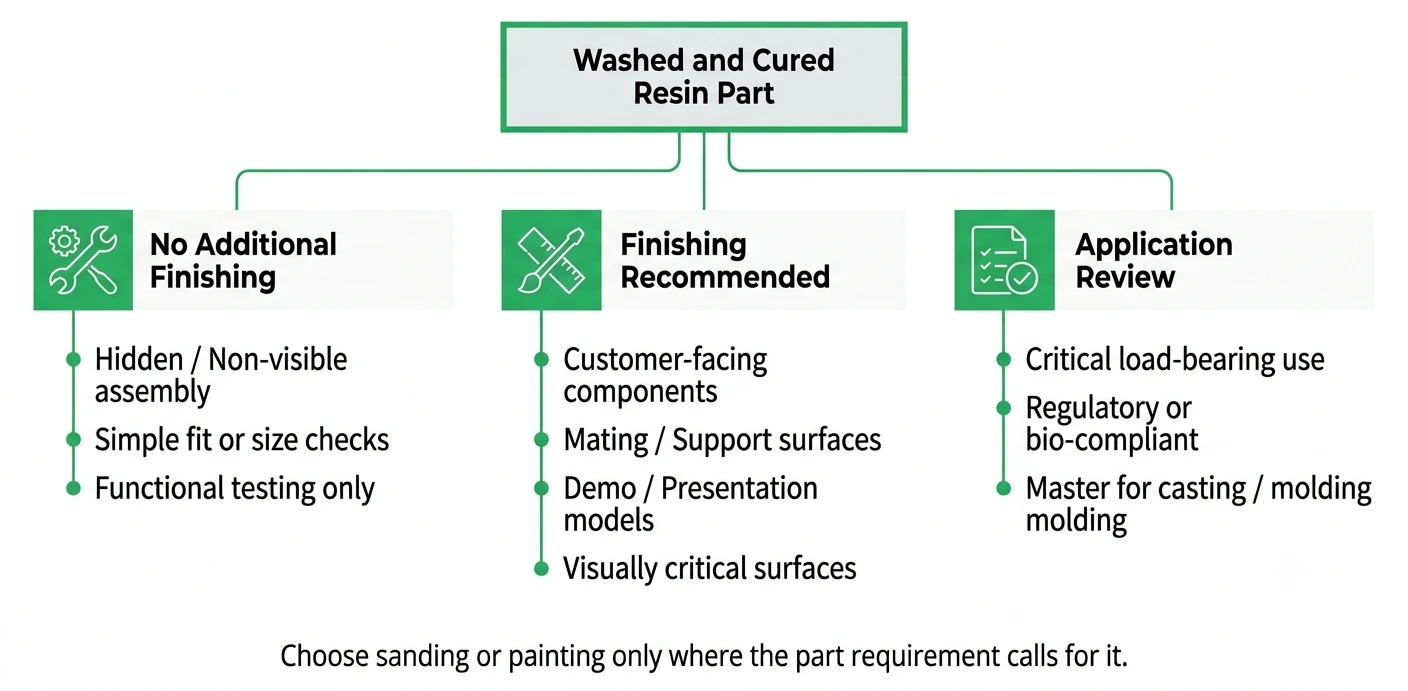
When Resin 3D Printed Parts Don't Need Extra Finishing
Some resin 3D printed parts may be suitable for use after washing and curing, depending on their purpose.
Hidden or internal components: If the part is placed inside an assembly and is not visible, a clean and cured surface may be sufficient.
Fit-check or form prototypes: When the part is used to validate size, geometry, or assembly fit, additional finishing may not be required.
Functional test parts: For basic testing such as clearance checks, snap-fit evaluation, or assembly trials, surface finishing may not affect the test result.
Parts used for further processing: If the part is used as a master pattern or as input for another process, the next process may define the final surface requirement.
When Resin 3D Printed Parts Require Finishing
Additional finishing becomes important when the part’s surface affects appearance, fit, handling, or final application use.
Visible or customer-facing parts: If the part is used in a product demo, presentation model, or visible assembly, sanding or painting may be required to achieve a more finished look.
Tight-tolerance assemblies: Support marks or surface variation can affect mating surfaces. In such cases, sanding may help improve fit.
Enclosure components: Resin 3D printed enclosure parts used for product validation or customer presentation may need matte or glossy painting based on the required appearance.
Parts under mechanical load: Proper curing is important when the part will be tested under load. Additional finishing should be selected only if it supports the part’s fit, surface requirement, or application use.
Biocompatible or regulated parts: These parts may need specific curing and handling conditions. Finishing should be reviewed based on the application requirement.
Post-Processing Decision Guide for Resin 3D Printed Parts
Once a resin 3D printed part is washed and cured, the next decision depends on its final use. A hidden bracket inside an assembly may not need additional finishing. A visible enclosure component or presentation model may need sanding or painting to achieve the required appearance and surface finish.
At Mech Power, sanding and painting are applied based on the actual part requirement. Sanding is available in dry and wet options. Painting is available in matte and glossy finish. This helps engineers select the right finishing level instead of applying the same post-processing steps to every resin 3D printed part.
Get Resin 3D Printed Parts with Mech Power
At Mech Power, we provide resin 3D printing services for prototypes, custom components, enclosure parts, and production requirements where detail, surface finish, and dimensional accuracy matter.
Our resin 3D printing process supports controlled printing and curing. For parts that need additional post-processing, Mech Power offers dry sanding, wet sanding, matte painting, and glossy painting based on the part’s final use.
Engineers can upload their 3D design files on our Instant Parts Quote tool to check pricing and place orders for resin 3D printed parts. Our resin 3D printing design guidelines can also help review wall thickness, fine details, and geometry before uploading the file.
Final Thoughts
Post-processing should be selected with purpose. Not every resin 3D printed part needs sanding or painting. Some parts only need washing and curing, while others need finishing for better appearance, fit, or final application use.
Choosing the right finishing level helps engineers avoid unnecessary steps and keep resin 3D printing efficient for prototypes, custom parts, enclosure components, and production runs.
Use Mech Power’s Instant Parts Quote tool to check feasibility, get pricing, and place your resin 3D printing order online. If you need support in choosing the right post-processing approach for your part, contact our team.
FAQS
Frequently Asked Questions
No, washing and curing are required for every part, but additional finishing depends on the part's intended use.
Curing is a mandatory step that gives the part its final strength, while post-processing refers to optional finishing like surface treatment.
Yes, parts that are hidden, used for fit-checks, or built for functional testing typically don't need additional finishing.
It depends on the step. Curing affects strength directly, while finishing like sanding and painting mainly affects appearance and fit.
Engineers can upload their 3D design files on our Instant Parts Quote tool to get instant pricing for resin 3D printed parts.