

 0
0

Prototyping is the backbone of product development. Whether you are building a new industrial component, a consumer product, or a custom machine part, choosing the right manufacturing method can directly impact cost, speed, and quality.
Two of the most widely used methods today are CNC machining and 3D printing. Both are powerful, but they serve different purposes. Understanding the difference between CNC machining vs 3D printing helps you make better decisions for your projects.
In real-world projects, engineers often use both technologies at different stages to balance speed, accuracy, and functionality. This guide breaks down the key differences so you can make a more informed decision for your prototype.
What is CNC Machining?
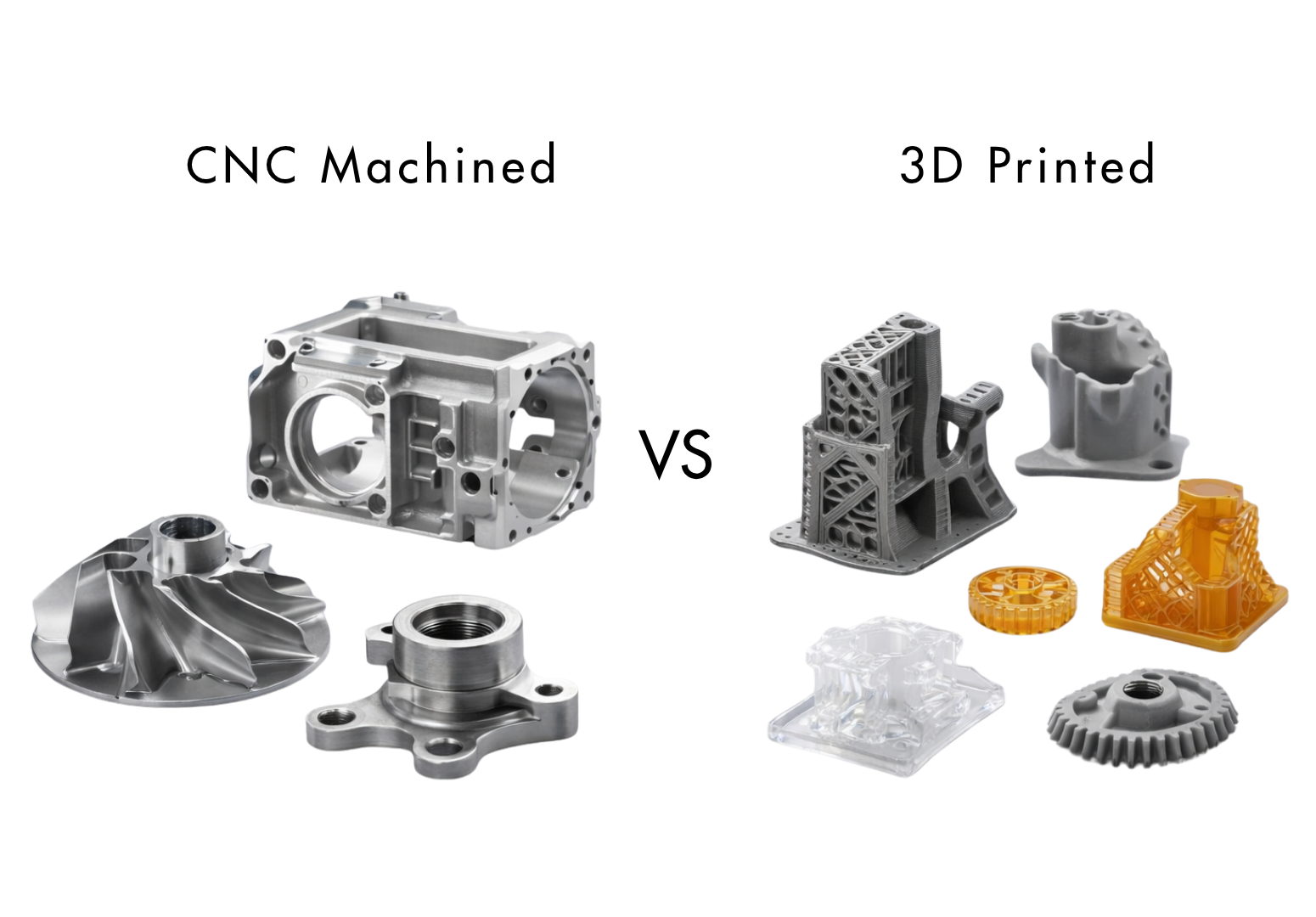
CNC machining is a subtractive manufacturing process. It removes material from a solid block using cutting tools to achieve the final shape.
Machines such as CNC milling machines and metal CNC cutting machines follow precise digital instructions to manufacture parts with high accuracy.
Key Features of CNC Machining
High precision and tight tolerances
Smooth surface finish
Suitable for metals and rigid plastics
Ideal for functional prototypes and end-use parts
This makes CNC machining service a reliable choice for load-bearing and performance-critical components.
What is 3D Printing?
3D printing is an additive manufacturing process. It builds parts layer by layer from digital models using materials like plastic, resin, or metal powders.
An online 3D printing service such as FDM and resin printing allows you to upload your design and get prototypes quickly without tooling.
Key Features of 3D Printing
Fast turnaround time
Ideal for complex geometries
Minimal material waste
Wide range of design flexibility
A 3D printing service is best suited for early-stage prototypes, concept models, and low-volume production.
Subtractive vs Additive Manufacturing: Core Difference
Understanding subtractive vs additive manufacturing is essential before comparing both methods.
Aspect | CNC Machining (Subtractive) | 3D Printing (Additive) |
Process | Removes material | Adds material layer by layer |
Waste | Higher material waste | Minimal waste |
Complexity | Limited by tool access | Handles complex designs easily |
Strength | Strong and durable | Depends on material and process |
CNC vs 3D Printing for Prototypes: Detailed Comparison
1. Speed and Turnaround Time
3D printing is faster for early-stage prototypes. You can get parts within hours or days without setup.
CNC machining requires programming, setup, and tooling, which can increase lead time.
Best Choice:
Quick concept models → 3D printing
Functional prototypes → CNC machining
2. Material Options
CNC Machining Materials
CNC machining offers a wider range of production-grade materials such as aluminum, steel, and engineering plastics.
Aluminum
Steel
Brass
Titanium
Engineering plastics
3D Printing Materials
3D printing materials are continuously evolving, but their mechanical properties may vary depending on the process.
PLA, ABS, PETG
Pro-BLK 10, Rigid White, Flex-BLK 20
Nylon
Metal powders
3D printing materials are improving, but CNC machining remains the preferred option, for applications requiring structural reliability.
3. Precision and Accuracy
When it comes to precision machining vs 3D printing, CNC machining clearly leads.
CNC tolerances: ±0.001 inches or better
3D printing tolerances: ±0.1–0.3 mm (varies by process)
If your design includes CNC milling machine parts or tight-fitting parts, CNC is the better option.
4. Surface Finish
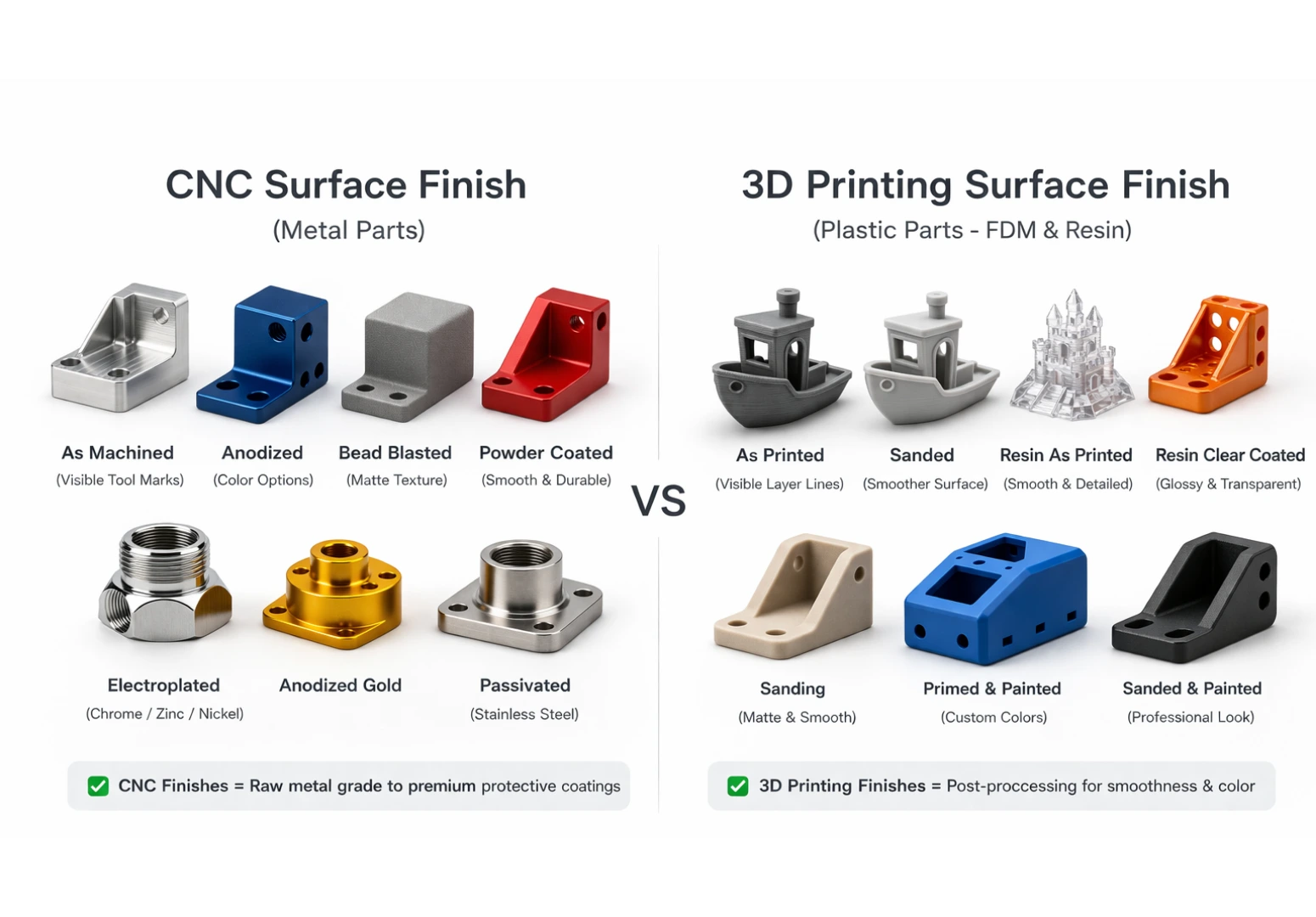
The difference in surface finish CNC vs 3D printing is noticeable. Surface finish is not just about appearance. It directly affects fit, functionality, and how the part performs in real-world use.
CNC parts: Smooth and ready for use
3D printed parts: Layer lines visible, often need post-processing
If aesthetics and finish matter, CNC machining delivers superior results.
5. Design Flexibility
3D printing allows complex geometries such as internal channels, lattice structures, and organic shapes that are difficult to achieve with machining.
CNC machining, however, is limited by tool access and cutting angles.
Best Choice:
Complex design → 3D printing
Simple, precise parts → CNC machining
6. Strength and Durability
CNC-machined parts are manufactured from solid material, which gives them consistent strength and durability.
3D printed parts may have weaker bonding between layers depending on the process and orientation.
Best Choice:
Functional testing → CNC machining
Visual prototypes → 3D printing
7. Cost Comparison CNC vs 3D Printing
The cost comparison CNC vs 3D printing depends on geometry, quantity, and stage of development.
3D Printing Cost Factors
Material type
Build time
Size of part
CNC Machining Cost Factors
Setup time
Tooling
Material cost
General Rule:
Low quantity + complex design → 3D printing is cheaper
Higher quantity + simple design → CNC machining is more cost-effective
Rapid Prototyping Methods Comparison
When comparing rapid prototyping methods, both technologies play a role at different stages.
Stage | Recommended Method |
Concept validation | 3D printing |
Design testing | 3D printing |
Functional testing | CNC machining |
Pre-production | CNC machining |
Using both methods together often delivers the best results.
Applications of CNC Machining
CNC machining is widely used for:
Automotive parts
Aerospace and defence parts
Industrial equipment
Medical devices
Custom prototype manufacturing
It is ideal when performance and durability are essential.
Applications of 3D Printing
3D printing is commonly used for:
Concept models and visual prototypes
Design validation and fit checks
Lightweight structures
Enclosures and casings
3D printing enclosure development
It works well when design flexibility is the priority.
When to Choose CNC Machining
The decision often depends on whether the part is for validation, testing, or final use.
Choose a CNC machining service if you need:
High precision
Strong materials
Smooth surface finish
Functional prototypes
Metal parts
It is especially useful for parts made using a metal CNC cutting machine.
When to Choose 3D Printing
Choose an online 3D printing service if you need:
Fast turnaround
Complex geometry
Low-cost prototypes
Early-stage design validation
Combining CNC and 3D Printing
In many real-world projects, the most effective approach is to use both technologies strategically.
Example Workflow
Start with 3D printing for quick validation
Refine the design
Use CNC machining for functional testing
Move to production
This hybrid approach reduces cost and improves overall development efficiency.
Common Mistakes to Avoid
Choosing 3D printing for load-bearing parts
Using CNC machining for highly complex internal designs
Overlooking surface finish requirements
Not planning for scalability
Selecting the wrong method can increase cost and delay timelines.
How Mech Power Helps You Choose the Right Path
At Mech Power, we provide both CNC machining service and 3D printing service to support every stage of product development.
Our Capabilities Include
High-precision CNC machining for functional parts
FDM and Resin 3D printing solutions for rapid prototyping
Wide range of materials
Fast turnaround time
Custom parts manufacturing
We help engineers choose the right process based on design, budget, and timeline. Explore our customization capabilities guide to find the best solution for your prototype.
Get Instant Pricing for Your Parts
Simplify your sourcing process with our Instant Quote tool for instant pricing on 3D printing and sheet metal parts, helping you move faster from design to production. Upload your design, select specifications and get quick pricing to plan your next steps efficiently.
For complete fabrication needs including custom builds and assemblies, submit your inquiry and our team will assist you.
Final Thoughts
Choosing between CNC machining vs 3D printing is not about which is better, it is about using the right method at the right stage.
3D printing helps you move fast.
CNC machining helps you validate performance.
A smart combination of both methods ensures faster development, lower costs, and better results.
Ready to Build Your Prototype?
Looking for reliable CNC vs 3D printing for prototypes solutions?
Mech Power offers expert support, advanced technology, and end-to-end manufacturing services to bring your ideas to life.
Contact us today to get started with your next prototype.
FAQS
Frequently Asked Questions
CNC machining removes material from a solid block, while 3D printing builds parts layer by layer.
It depends on the requirement. 3D printing is better for early designs, while CNC is ideal for functional prototypes.
CNC machining can be more expensive for small quantities, but it becomes cost-effective for larger production runs.
Common materials include PLA, ABS, resin, nylon, and metal powders.
Yes, many projects use both methods for different stages of prototyping and production.